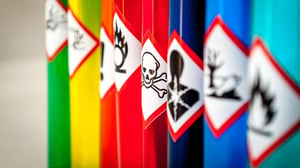
If you, as a distributor, downstream user, manufacturer or importer, purchase and pass on products, components, mixtures or materials, a generic “SVHC-free” in the supplier declaration is not sufficient. What matters is whether a substance of very high concern is on the current SVHC Candidate List, in which product type it is present, and what role your company plays in the supply chain. Including a substance on the list in particular triggers information obligations under REACH—for articles at a concentration of more than 0.1 percent by weight, and in certain cases an additional notification obligation to ECHA. At the same time, the Candidate List is moving: new substances can be added, existing entries can be clarified, and individual substances may later be prioritized for authorization or restriction. This article explains how the list is updated and what you should pay attention to going forward.
What is the SVHC Candidate List?
The SVHC Candidate List is a list of substances of very high concern published by the European Chemicals Agency (ECHA). SVHC stands for “Substances of Very High Concern.” The legal basis is in particular Article 59 of the REACH Regulation (EC) No 1907/2006. Substances considered include, among others, carcinogenic, mutagenic or reprotoxic substances as well as persistent, bioaccumulative and toxic substances (PBT), very persistent and very bioaccumulative substances (vPvB), and substances with an equivalent level of concern.
Inclusion on the Candidate List is not a general ban. As a rule, a listed substance may continue to be manufactured, used and placed on the market unless another measure—such as a restriction or an authorization requirement under REACH—applies. However, inclusion is an important regulatory step: it can immediately trigger information, safety data sheet and notification obligations and is often a signal for later inclusion in Annex XIV of the REACH Regulation.
What are the consequences of inclusion in the Candidate List?
The specific obligation depends on whether your company supplies the substance as such, in a mixture or in an article. The following scenarios are particularly important:
|
Company role or product
|
Main consequence of inclusion
|
|
Supplier of a substance or mixture
|
Check whether a safety data sheet is required and whether it needs to be updated due to the SVHC property. Pass relevant information along the supply chain.
|
|
Supplier of an article
|
If the article contains a Candidate List substance in a concentration of more than 0.1 percent by weight, you must provide industrial or professional recipients with sufficient information for safe use—at a minimum the name of the substance.
|
|
Supplier of an article to consumers
|
Upon request, the information under Article 33(2) of REACH must be provided free of charge within 45 days.
|
|
Producer or importer of articles
|
In addition, a notification to ECHA under Article 7(2) of REACH may be required if the threshold of a total of more than 1 tonne per year and the other conditions are met.
|
|
Downstream user
|
Review uses, safe working conditions, supplier information and potential information obligations; if there are changes, update your own use and communications.
|
|
Distributors and retailers
|
Pass information from the supply chain on to customers, handle consumer and customer inquiries, and ensure that product data and safety information match the goods offered.
|
|
Procurement and supply chain
|
Take SVHC-relevant information into account in supplier requirements, purchase orders and evaluations, and track updates.
|
How is a substance added to the SVHC Candidate List?
Inclusion does not happen automatically through a single classification or a supplier declaration. It is the result of a formalized procedure under Article 59 of REACH:
-
A Member State or ECHA at the request of the European Commission prepares a dossier under Annex XV to REACH. It sets out why a substance meets the criteria for a substance of very high concern.
-
The planned submission is published in the Registry of SVHC Intentions. Companies, associations and other stakeholders can thus see early on which substances are being prepared for listing.
-
After the dossier is submitted, a public consultation is held. Stakeholders can in particular contribute information on uses, volumes, exposure, risks and possible alternatives.
-
The Member State Committee (MSC) evaluates the proposal. If unanimity is reached, ECHA includes the substance in the Candidate List. If unanimity is not reached, the European Commission decides under the REACH procedure.
-
After inclusion, ECHA publishes the updated entry. From this point on, the relevant obligations under REACH may apply immediately.
For companies, this means: Publication of a draft dossier or an SVHC intention is not the same as inclusion in the Candidate List. However, it is an important early warning signal for compliance, procurement, product development and substitution decisions.
What records should companies retain?
For an auditable assessment, companies should compile at least the following documents:
-
Version and retrieval date of the ECHA Candidate List reviewed;
-
Assessment of the substance entry including identifiers and any substance groups;
-
affected products, articles, components and material numbers;
-
supplier declarations, safety data sheets and other material information;
-
determination of concentrations and quantities including underlying assumptions;
-
decision on information obligation, ECHA notification, exemption or non-applicability;
-
information transmitted, recipients, dispatch date and version;
-
consumer inquiries, responses and proof of the 45-day deadline;
-
substitution assessments and approvals for affected substances.
What to expect next for the SVHC Candidate List?
The Candidate List is designed as an ongoing regulatory process. Companies should therefore not only react to the next published entry, but monitor developments upstream. From today’s perspective, the following developments are particularly relevant:
|
Expected development
|
Relevance for companies
|
|
Further inclusions and updated entries
|
The list will continue to grow. In addition, existing entries may be updated regarding hazard properties, substance groups or identifiers. Material and supplier data must therefore be checked regularly against the current ECHA version.
|
|
Earlier signals via the Registry of SVHC Intentions
|
The registry makes planned dossiers visible before formal inclusion. Companies can thus assess uses, alternatives and supply chain information at an earlier stage.
|
|
More group-based assessments
|
For substance groups, a single list change can cover multiple chemical substances or related identifiers. This makes simple CAS-number matching more difficult and increases the importance of a substantive review of the ECHA entry.
|
|
Closer link to authorization and restriction
|
Substances on the Candidate List may later be prioritized for inclusion in Annex XIV. Independently of that, substances may also be subject to a restriction procedure under Annex XVII. Inclusion on the Candidate List is therefore an early warning signal, but not yet a decision on the later regulatory instrument.
|
|
Further digitalisation of substance information
|
ECHA is migrating regulatory information to ECHA CHEM and keeping the previous presentation up to date in parallel during the transition phase. Companies should align their monitoring and data processes with ECHA data sources and document retrieval dates.
|
|
More attention to substance groups such as PFAS
|
The ongoing work on PFAS shows that authorities assess substance groups in a coordinated manner and link different regulatory pathways. For companies, this means: Monitor not only individual well-known substances, but also relevant substance groups and related entries.
|
Which changes to the Candidate List trigger immediate action?
Immediate action is required in particular when a new substance is added, when an existing entry is extended to additional substances or properties, or when identifiers and entry descriptions change. Distributors and downstream users should then check whether the change affects products already offered or used, whether information needs to be passed on to customers, and whether safety data sheets, product data or internal approvals need to be adjusted.
Conclusion: Establish SVHC review as a standing process
The SVHC Candidate List is not merely a directory of substances, but a trigger for specific tasks in the supply chain. Manufacturers, importers, suppliers and downstream users must determine whether Candidate List substances are present in substances, mixtures, articles or components, which thresholds apply and which information must be passed on.
The most important next step is a documented stocktake: review the current ECHA list, identify affected products and suppliers, assess information and notification obligations, and assign responsibilities with deadlines. This turns a one-off search into a robust REACH process.
Sources
Candidate List of substances of very high concern for Authorisation , Registry of SVHC intentions until outcome, Substances of very high concern identification, Candidate List substances in articles, Summary of obligations linked to the Candidate List, REACH Regulation (EC) No 1907/2006, REACH information